

Blog
Industrial Exhaust Hood Design That Works
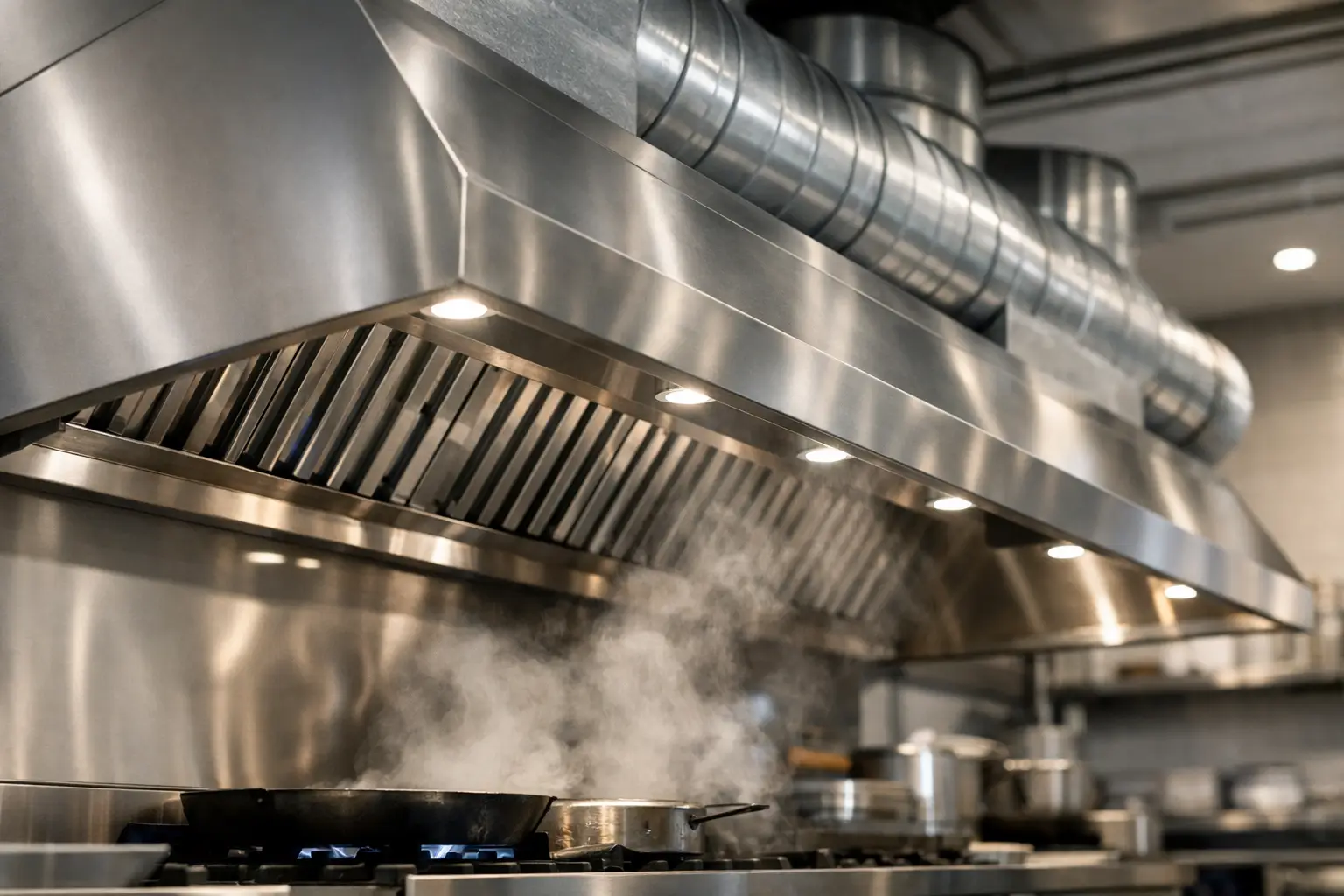
When an extraction system underperforms, the problem usually starts at the hood. Fans, ductwork and filters matter, but if the hood is the wrong size, shape or position, the whole system ends up fighting the process instead of controlling it. Good industrial exhaust hood design is what turns airborne heat, grease, fumes, dust and vapours into a manageable engineering problem rather than an ongoing site headache.
For factories, workshops, commercial kitchens and process areas, the hood is the first capture point. Get that capture right and the rest of the system has a fair chance of performing efficiently. Get it wrong and you see the familiar signs straight away – poor air quality, heat build-up, residue on surrounding surfaces, uncomfortable staff, higher cleaning demands and unnecessary energy use.
What industrial exhaust hood design actually needs to achieve
At a practical level, an exhaust hood has one job: capture contaminants at source before they spread into the room. That sounds straightforward, but in real operating environments there is always interference. Cross-draughts from doors, supply air, moving equipment, cooking appliances, production lines and staff movement all affect how airborne contaminants behave.
That is why effective industrial exhaust hood design is never just about making a canopy bigger and adding more extraction. Oversizing can increase capital cost and running cost without improving capture. Undersizing creates obvious performance failures. The right design balances hood geometry, airflow rate, mounting height, extraction velocity and the nature of the contaminant itself.
Heat and grease from commercial cooking behave differently from fine dust in a fabrication workshop. Steam from wash areas behaves differently from solvent vapours in a process environment. Each application needs a hood designed around what is being generated, how fast it rises or disperses, and how close the hood can realistically sit to the source.
Why hood type matters more than many buyers expect
Not all hoods perform the same, even when they look similar on paper. The right format depends on the process, site constraints and cleanliness requirements.
Canopy hoods are common where heat and fumes rise naturally, particularly above cooking or open process equipment. They are effective when positioned correctly, but they rely on thermal lift and can lose efficiency if mounted too high or exposed to strong lateral air movement.
Side-draught and back-draught hoods suit applications where contaminants can be pulled horizontally from a predictable point of generation. These can work well in workshops and certain industrial processes, especially where overhead positioning is impractical.
Enclosed or semi-enclosed hoods generally deliver stronger capture efficiency because they reduce the amount of room air being pulled into the system. That can improve control and reduce required airflow, but there is a trade-off. Access for operators, cleaning and maintenance needs to remain practical.
This is where experience matters. A hood should fit the process, not force the process to adapt around a standard product that was never intended for the site.
The main design factors that affect performance
Capture distance
The further the hood sits from the source, the harder the system has to work. Extraction velocity drops quickly with distance, so a hood mounted for convenience rather than performance often becomes expensive to run and disappointing to use. Where possible, the design should bring the hood close enough to capture contaminants early without obstructing operations.
Hood size and shape
A larger hood opening is not automatically better. The opening geometry affects how air enters the hood and how evenly contaminants are drawn in. Poor proportions can create dead zones where fumes or particles escape. Well-made stainless steel fabrication also matters here because clean edges, accurate forming and consistent dimensions help deliver predictable airflow.
Air volume and face velocity
The system must move enough air to capture and contain the contaminant, but not so much that it creates turbulence or wastes energy. This is one of the biggest areas where generic sizing causes problems. Real design work means matching airflow to the actual duty, not relying on guesswork.
Thermal currents and cross-draughts
Hot processes create rising air streams. Doors, make-up air systems and nearby machinery create competing air movement. A hood that performs well in a static test can struggle badly on a busy site floor if these influences are ignored. Positioning, baffle design and surrounding airflow management all play a part.
Duct connection and system resistance
Even a well-designed hood will underperform if the duct route is restrictive. Tight bends, poor transitions and long runs increase pressure losses and reduce real capture performance. Hood design should be considered alongside the full extraction path, not as a standalone item.
Industrial exhaust hood design and compliance
Buyers usually come to the table with two concerns: performance and compliance. In reality, those concerns overlap. A poorly designed hood is more likely to lead to hygiene issues, poor indoor air quality, heat stress, grease accumulation or ineffective contaminant control, all of which can create operational and regulatory problems.
In commercial kitchens, for example, extraction has to deal with grease, heat and vapour while supporting a cleaner, safer cooking environment. In manufacturing and workshop settings, the focus may be fumes, dust or process emissions. The specific compliance route varies by application, but the principle stays the same: source capture must be effective, maintainable and suited to the risk.
That also means thinking beyond first installation. Access for cleaning, filter arrangement, removable sections and material choice all affect whether the system remains compliant over time. Stainless steel is often the sensible choice because it is durable, hygienic and well suited to demanding environments.
Custom design versus off-the-shelf hoods
Standard hoods have their place. If the duty is straightforward and the space is conventional, an off-the-shelf option can be a sensible route. But many sites are not straightforward. Ceiling heights vary, services get in the way, equipment layouts are fixed, and extraction routes need to avoid structural constraints or neighbouring systems.
That is where custom industrial exhaust hood design pays for itself. A bespoke hood can be sized correctly, built around the equipment footprint, matched to the required extraction volume and fabricated to suit the installation route. It also helps avoid the all-too-common compromise of fitting a standard canopy into a non-standard space and hoping the fan can compensate.
For buyers, the real value is fewer compromises. Better capture, cleaner installation, easier maintenance and lower lifetime frustration are usually worth more than a small saving on the initial purchase price.
Energy efficiency is part of good design
Extraction should solve a problem, not create a new one in the energy bill. If a hood needs excessive airflow to achieve basic capture, the system becomes more expensive to run. That affects fan power, replacement air requirements and, in temperature-controlled spaces, heating costs as well.
Efficient industrial exhaust hood design reduces wasted air by improving capture at source. Enclosing the process where practical, optimising hood position and using the right geometry all help reduce the volume of air that has to be moved. This is a more commercially sound approach than overspecifying the fan and accepting permanent inefficiency.
It also improves consistency. A system designed with sensible airflow margins is less likely to fall apart in real conditions than one that only works because it is running flat out.
Common mistakes that lead to poor extraction
The most common error is designing around available space rather than process behaviour. If the hood only fits because it is mounted too high or too far away, capture performance will suffer. Another frequent issue is treating the hood, ducting and fan as separate purchases instead of one coordinated system.
Material choice is another area where corners get cut. In demanding environments, light-duty fabrication can distort, degrade or become difficult to clean. For sites that need dependable long-term performance, build quality matters.
There is also a tendency to assume that more airflow fixes everything. In practice, excess airflow can increase noise, disrupt the process and add operating cost without solving the root issue. Better design usually beats brute-force extraction.
What buyers should ask before approving a hood design
A serious supplier should be able to explain how the hood captures the contaminant, why the hood type suits the application, what airflow the system is designed around, and how installation constraints have been accounted for. They should also be clear about cleaning access, material specification and how the hood integrates with ductwork, filtration and fan selection.
This is especially important on custom projects. A proper design conversation should cover process details, working heights, equipment layout, heat load, contamination type and maintenance needs. If those questions are not being asked, the design may be based on assumptions rather than site reality.
That is why many commercial and industrial buyers prefer working with a manufacturer that can design, fabricate and support installation as one joined-up package. It reduces gaps between specification and delivery, and it gives you a clearer line of responsibility when performance matters. At CanopyMan, that practical, end-to-end approach is often what makes the difference between a system that simply looks the part and one that genuinely performs.
The best hood design is rarely the most complicated. It is the one that fits the process, captures contaminants reliably, stands up to daily use and keeps operating costs under control. If the hood is doing its job properly, the whole site feels the benefit long after installation day.
 Canopy
 Fans
Fans Stainless Steel Sheets
 ESP
ESP Cold room